Bolzano · Go deeper
Getting around
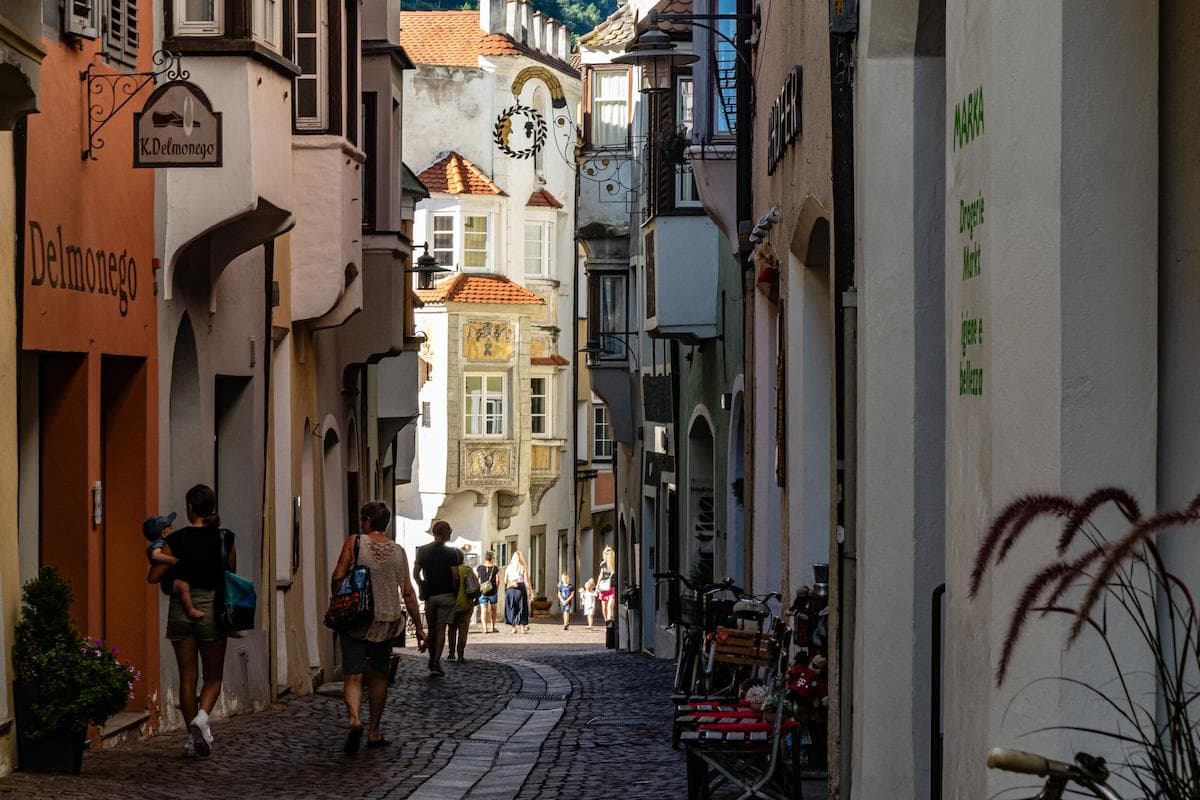
Bolzano, then: you can live here without a car, your airports are Verona and Innsbruck, and this is the gateway to the Dolomites. It’s a compact, walkable city with an excellent bus network and some of the best cycling infrastructure in Italy, so daily life in town runs on foot, on a bike, and on the odd bus. Bolzano sits right on the Brenner line, the main rail artery through the Alps, which puts Verona and the rest of Italy to the south and Innsbruck across the Austrian border to the north. You’ll want wheels for the high mountain valleys and the ski areas, but for the city itself, and for the main journeys out, you rarely need to drive.
Getting there
By air, the long-haul leg
Arriving from far away, you’ll connect through a major European hub, then finish by a short flight or a train down into the valley; there’s no long-haul service into Bolzano itself. Fly the long leg into a big European gateway and come the rest of the way by air to Verona or Innsbruck, or by rail.
Verona and Innsbruck, the airports you’ll actually use
Bolzano has two practical gateways, roughly a similar distance apart in opposite directions: Verona to the south and Innsbruck over the Austrian border to the north, each about an hour and a half to two hours by car or train, each with a solid spread of domestic and European routes. Between them you have good coverage north and south.
By train
Bolzano sits on the Brenner corridor, the main north-south rail line through the Alps, so fast and regional trains run through all day. Verona and the rest of Italy lie south, Innsbruck and Austria north. Rough times below. For most arrivals the train is the easiest way in.
By car
The A22 Brennero autostrada runs right past Bolzano up the valley, from Verona in the south to the Brenner Pass and Austria in the north. It’s an easy drive, and it’s the thing that unlocks the high side valleys and the ski areas, even if you rarely need it inside the city.
Around the city
On foot
The center is compact, handsome, and arcaded, and most daily life in town happens on foot. The old core around the Walther square and the market streets is made for walking, so everyday errands you simply do on foot.
By bike
Bolzano is one of Italy’s most bike-friendly cities, with an extensive network of cycle paths along the rivers and through town, plus a bike-share. A huge share of residents commute by bike in the warmer months; in deep winter, less so, but the infrastructure is there year-round.
City and regional buses (SASA)
Bolzano has an excellent, punctual urban bus network run by SASA, plus regional routes reaching out into the valleys. Single tickets are cheap and day tickets are modest, and this is a city where public transport works. South Tyrol sells them through its integrated provincial fare system, so check the current prices on SASA ›
A note on driving and parking
There’s a limited-traffic zone (ZTL) in the historic center, so you don’t drive into the old core, you park at the edge and walk in. Parking is manageable otherwise. Many residents keep a car only for the mountains and weekends and leave it parked during the week.
Cable cars, a Bolzano quirk worth knowing
Bolzano has funivie, cable cars, that climb straight from the city up to the villages and plateaus above it: Renon/Ritten, San Genesio, and Colle. For the people who live up top these are everyday public transport, not just a tourist ride, and they run to a timetable like any bus line.
Intercity coaches (FlixBus / Itabus)
The cheap way to move between cities, FlixBus and similar run to the bigger northern destinations. Slower than the train on most routes here, but sometimes cheaper, worth checking both. Routes and fares on FlixBus ›
Train connections — from Bolzano station
Bolzano sits on the Brenner line, so the region’s hubs and the cities beyond are a easy ride away. Rough fastest times:
Trento
about 35–45m
Verona
about 1h 30m
Innsbruck (Austria)
about 2h
Venice
about 3h (change at Verona)
Milan
about 3h 30m (change at Verona)
Merano
about 40m
Rough fastest times, check Trenitalia for live schedules.
One note
One thing to understand about Alpine travel: it follows the valleys. You can’t just cut across country to the next valley over, the mountains decide the routes, so a trip that looks short on a map can mean heading down one valley and up another. Bolzano’s saving graces are the Brenner rail line running right through it, which makes the main north-south journeys easy, and the cable cars that lift you straight up to the villages above. Plan around the ridgelines and it’s remarkably well connected for the mountains.