Lucca · Go deeper
Where to live
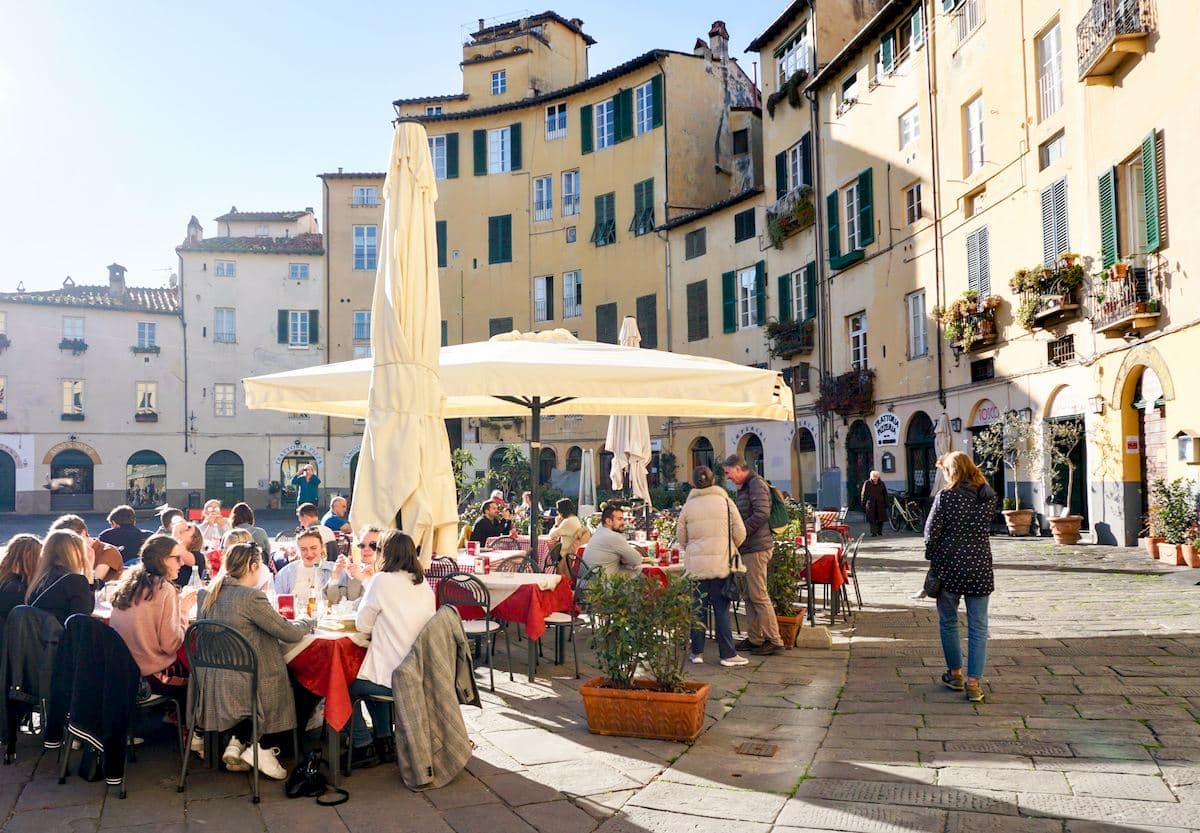
Lucca divides on one line: the walls. Inside is the compact, car-light historic centre; outside are the everyday residential districts that ring it, the same beautiful city, at very different prices. The gap between inside and outside is mostly money.
Inside the walls
Centro Storico
most expensiveThe magic of Lucca: the walled historic centre, where the oval Piazza dell'Anfiteatro, Via Fillungo's shops, and doorstep cafés and markets all sit within a flat, car-light few minutes' walk. It's beautiful, atmospheric, and endlessly liveable, which is exactly why it's the priciest place in the city. Strict low-emission limits, small old apartments, and awkward parking outside the gates.
Best for: those who want to live inside the walls, a flat walk from Via Fillungo
Learn more about the historic heart
Lucca’s walls are the whole story. Built from the mid-1500s as the age of cannon arrived, they run four kilometres right around the old city, eleven great bastions, unbroken, and they were never once needed in battle; the only time the gates were shut in anger was against a flood in 1812. When the fighting age passed, Lucca did something rare: instead of tearing its walls down, it planted them, turning the ramparts into a wide, tree-lined promenade that still circles the city, where residents walk and cycle the loop every day.
Behind those walls Lucca stayed its own master for centuries, one of only a handful of Italian city-states to keep its independence as a republic until Napoleon finally ended it. It’s a city that produced beauty rather than conquest: the oval Piazza dell’Anfiteatro traces the ring of a Roman amphitheatre, and in 1858 Lucca gave the world Giacomo Puccini, composer of La Bohème and Tosca, born a few streets from the cathedral. Free, walled, and musical. That’s the centre in three words.
Outside the walls
San Concordio (south, by the station)
mid, practicalA practical residential grid just south of the walls, right by the train station, effortless for commuters, with everyday shops and cafés and better value than inside. The trade is that it's plainer, mid-century in feel, and busy with traffic near the station at peak hours.
Best for: commuters and anyone wanting rail access and value a short walk from the walls
Sant'Anna & the western districts
mid, familyA family-friendly district west of the walls, with schools, supermarkets, parks, and modern amenities, plus easy access to the A11 motorway. Less postcard-pretty than the centre, but comfortable, practical, and better value for space. This is where a lot of settled Lucca families live.
Best for: families wanting space, schools, and modern amenities near the centre
San Marco, Arancio & the outer quarters
mid, residential valueThe quieter residential pockets ringing the city: leafy San Marco and Monte San Quirico to the north with some period villas, and the newer, practical Arancio and San Filippo near the hospital to the east. More space, newer housing, and good value, at the cost of a bus or bike ride into the centre. Functional rather than scenic, but that's the point.
Best for: those wanting quiet, space, and value, happy to cycle or bus into the walls
Rough rents are indicative and move with the market. Check current listings on Idealista ›