Rome · Go deeper
Getting around
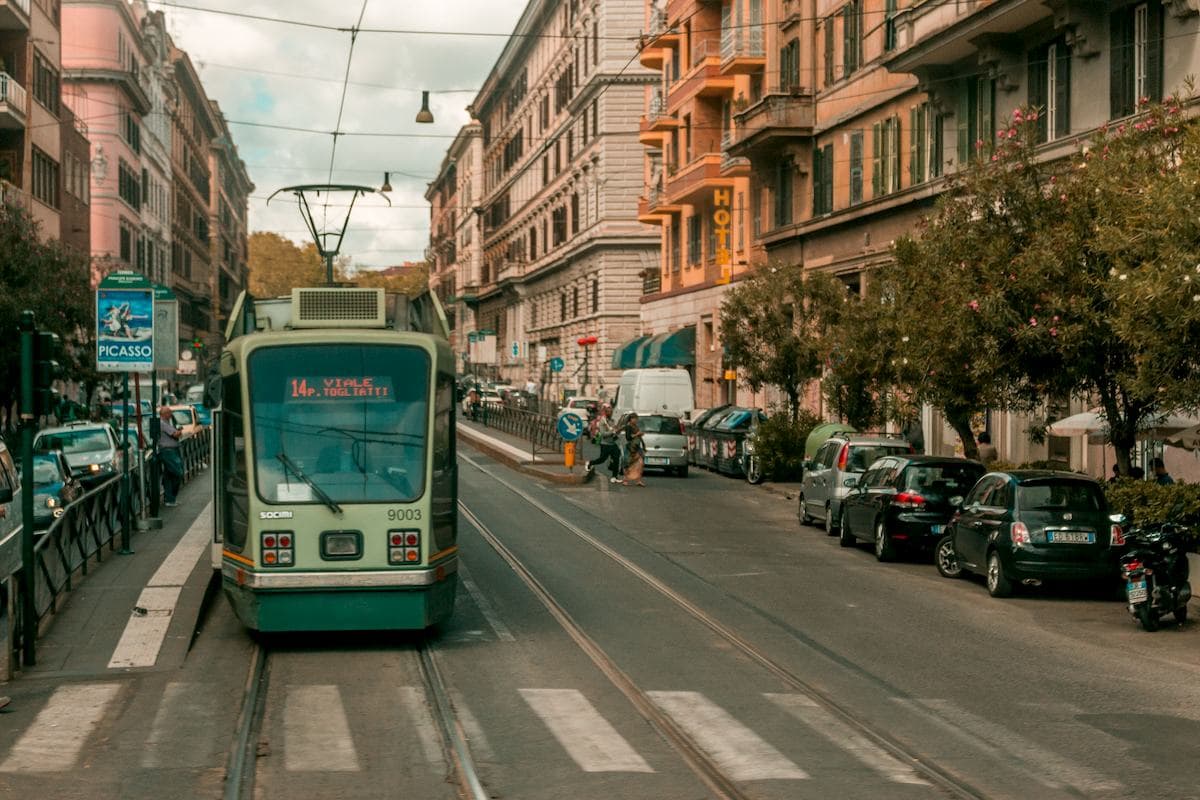
Rome, in short: you won’t need a car, but you’ll need patience. The centre walks end to end, the metro’s small for a city this size, and the buses cover the rest, slowly. What Rome’s got is the best airport in the country.
Getting there
Fiumicino (Leonardo da Vinci)
Italy’s main airport, about 30 km southwest, direct long-haul, the Atlantic included. The Leonardo Express runs nonstop to Termini in about 32 minutes, every 15 minutes, for €14.
Ciampino
The smaller second airport, southeast, mostly low-cost European flights. Shuttle bus to Termini or a city bus to the metro.
Around the city
On foot
The centre’s dense and walkable, often the fastest way across, since the ruins that block the metro keep the cars out. Cobbles, crowds at the landmarks, some hills. Comfortable shoes matter.
The metro
Three lines, A, B, and C, cross at Termini. Handy for longer hops and for the Vatican or the Colosseum, but thin for a city this big, because you can’t dig far here without hitting a ruin. So you’ll still walk and bus a lot.
Buses and trams (ATAC)
The real workhorse. A big bus network plus a few trams cover what the metro misses. Broad but slow in traffic. One ticket works across all three.
Tickets
A single’s about €1.50 for 100 minutes. Day, weekly, and monthly passes too, and tap-and-go caps your daily spend.
Learn more ›
Fares in full: single (BIT) €1.50 / 100 min · 24h €8.50 · 48h €15 · 72h €22 · weekly (CIS) €29 · monthly €35. Tap-and-go at the gates caps your day at the 24h price. Validate paper tickets or risk a fine.
The metro, in detail: Line A (orange) runs Vatican–Spagna–Termini–San Giovanni; Line B (blue) serves the Colosseum, Circus Maximus, and EUR; Line C is the new driverless line, still extending toward the centre. Runs about 5:30 to 23:30, later to 1:30 Friday and Saturday. It’s short for the city’s size because every dig hits archaeology. Line C tunnelled through twenty-one layers of history.
Night buses: after the metro stops, four N-lines shadow the metro routes (nMA, nMB, nMB1, nMC), doubled to every 8–10 minutes Thursday to Saturday.
Senior travel: Rome residents over 70 on a low income (ISEE up to €15,000) ride the whole network free, a personal annual card renewed each year. Those 65+ get a discounted annual pass, about €120–150 by income. Both need Rome residency.
Intercity coaches: FlixBus and Itabus run from Tibus at Tiburtina to cities across Italy, cheaper and slower than the train.
Train connections — from Roma Termini
Rome’s the hub of Italy’s high-speed network. Termini’s the main station, Tiburtina the second, and fast Frecciarossa and Italo trains run all day. Rough fastest times:
Naples
about 1h 10m
Florence
about 1h 30m
Bologna
about 2h
Milan
about 3h
Venice
about 3h 30m
A note on cars
Most people who live in central Rome skip the car, and the city makes that easy. If you’re thinking about one anyway: nearly all of the centre is a ZTL, a limited-traffic zone watched by cameras that read every plate, and a wrong turn is an automatic fine. You arrive on the GRA, the ring road that loops the city, then park outside the centre and take transit in. A car earns its keep only if you live in the outer districts or want regular trips out of town.
Times are typical fastest journeys and vary by service and time of day. Check live schedules on Trenitalia ›