Perugia · Go deeper
Where to live
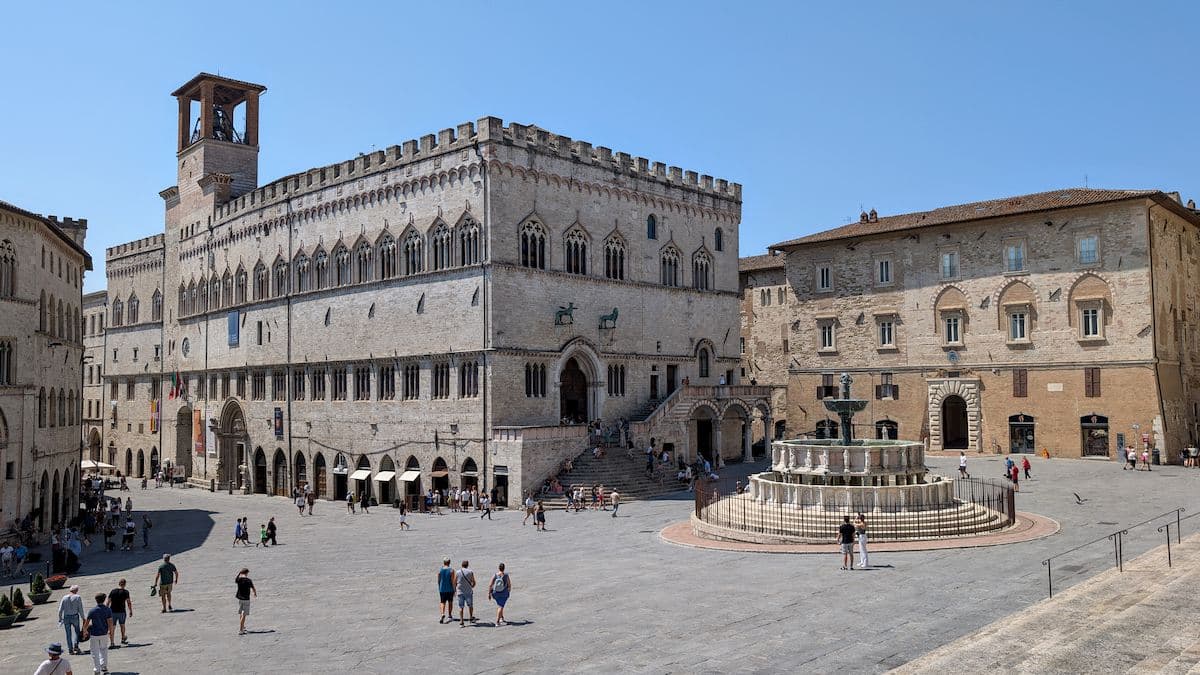
Perugia has a split personality of height: the historic centre crowns the hilltop, walkable and ancient around Corso Vannucci, while the university quarter and the modern residential districts spread out below and around it in the valley. Hilltop and valley run on different clocks, and different rents.
The historic centre
Centro Storico
most expensiveThe magnificent hilltop heart of Perugia: Etruscan gates, the grand Corso Vannucci, the Palazzo dei Priori, and the great medieval fountain on Piazza IV Novembre, all on foot, with two thousand years stacked in the same few streets. It's the most desirable place to live, full of cultural life, cafés, and the summer festivals, reached up the hill by the Minimetrò. The trade is cost, small old apartments, and the steep, car-limited streets.
Best for: those who want to live in the historic heart, on foot and among the history
Learn more about the historic heart
Perugia is older than Rome’s empire. It was one of the great cities of the Etruscans, and you can still walk through their walls: the Etruscan Arch, raised in the third century BC, its huge stone blocks later inscribed by the emperor Augustus after he besieged the city. In the Middle Ages Perugia grew rich and proud, and crowned its main square with the Fontana Maggiore, a fountain carved between 1275 and 1278 by Nicola and Giovanni Pisano, ringed with sculpted panels of the months and the sciences, beside the mighty Gothic Palazzo dei Priori on Corso Vannucci.
For all its age, Perugia feels young and worldly, and there’s a reason. Since 1921 the Università per Stranieri, the University for Foreigners, has drawn people from every corner of the world to learn Italian here, giving this Umbrian hill town a international, multilingual pulse. Add Umbria Jazz, one of Europe’s great music festivals, filling the medieval streets each July, and the historic centre carries a cosmopolitan energy you’d never guess from its ancient stone.
The university quarter
Elce
mid, young & centralThe university quarter just north of the centre: young, lively, and well-connected, with student venues, shops, and green space, and an easy walk or ride into the historic core. It's more affordable than the centre and full of energy, popular with students, academics, and young professionals. Term time is busy and loud with students; out of term it empties.
Best for: students, academics, and young residents wanting a lively, central-adjacent base
The valley and outer districts
Fontivegge & the valley (around the station)
mid, practicalThe valley district around the main station, Fontivegge: practical, well-connected by train, bus, and Minimetrò, and cheaper than the hill, with everyday shops and services. Lower-lying and a bit more humid than the airy hilltop, but you park outside your door and the Minimetrò does the climbing.
Best for: commuters and those wanting value and transport links below the historic centre
San Sisto, Ferro di Cavallo & the outer districts
mid, family valueThe modern residential districts spreading out around the city: San Sisto with its larger homes, villas, parks, and schools; Ferro di Cavallo, green and quiet in the hills; and the commuter suburbs like Ponte San Giovanni with their own train access. More space, gardens, and lower prices, in exchange for a bus, Minimetrò, or drive into the centre. This is where much of family Perugia lives.
Best for: families and residents wanting space, gardens, schools, and value around the city
Rough tiers are indicative and move with the market. Check current listings on Immobiliare ›