Vicenza · Go deeper
Where to live
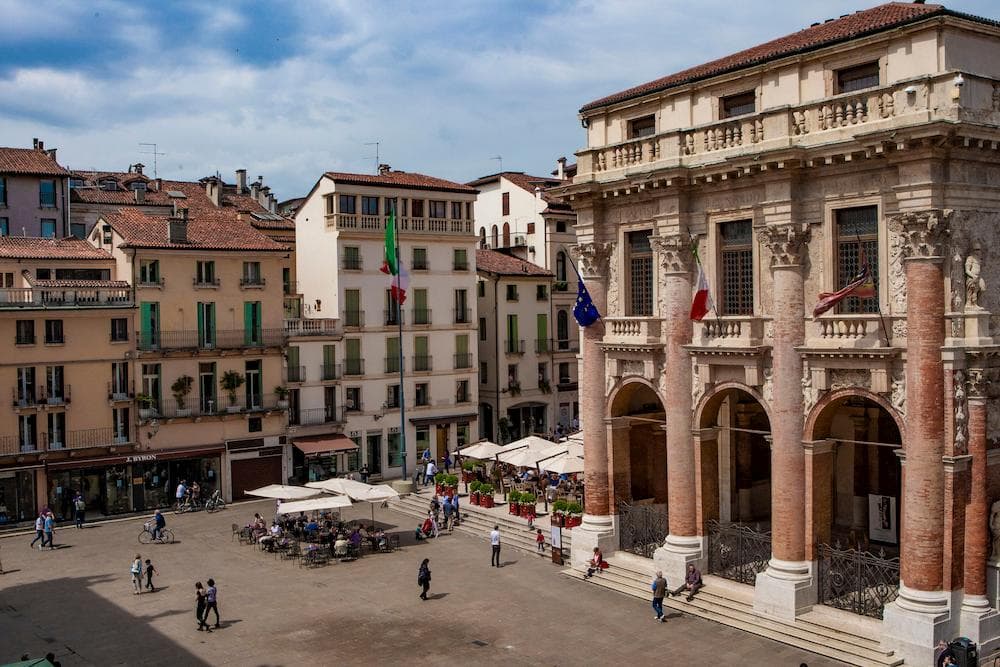
Vicenza is easy to read: the walled Palladian centre at its heart, the green hill of Monte Berico rising to the south, and the quieter residential borghi spreading out beyond. Which one suits you comes down to how much green you need.
The historic centre
Centro Storico
most expensiveThe walled Palladian heart of the city: the Basilica Palladiana on Piazza dei Signori, the Teatro Olimpico, and street after street of Renaissance palazzi, all compact enough to cross on foot in fifteen minutes. It's beautiful, cultured, and the easiest place to live without a car. The trade is cost: it's the priciest part of an already-affordable city, though still a bargain next to Verona or Venice.
Best for: those who want to live inside one of the great works of Renaissance architecture
Learn more about the historic heart
Vicenza is, more than any other city, the work of one man: Andrea Palladio. In the middle of the sixteenth century he reshaped the centre with palaces and public buildings drawn from a close study of ancient Rome: the great arcaded Basilica Palladiana on Piazza dei Signori is his, and twenty-three of his buildings still stand within the city walls. It’s why the whole of Vicenza is a UNESCO World Heritage Site.
His last work here was the Teatro Olimpico, begun in 1580, the oldest surviving indoor theatre in the world, with a fixed stage set of a receding street that has stood for over four hundred years. Palladio’s clear, classical style went on to become an architectural language of its own, Palladianism, copied across Europe and beyond for three centuries. Few small cities have influenced how the world builds as much as this one, or with as little fuss.
The hill
Monte Berico
premium, quietThe elegant, exclusive slope rising south of the centre, crowned by the Sanctuary of Monte Berico with its sweeping views over the city. Historic villas, leafy lanes, and old staircases that walk you back down into town make it a prestigious, peaceful address. The trade is that you're above and slightly apart from the centre, lovely, but a climb.
Best for: those wanting elegance, quiet, and a view over the city
The outer borghi
Near the station (Campo Marzo)
mid, practicalJust outside the medieval walls to the south, the station area connects to the centre in under fifteen minutes on foot along Viale Roma. It's practical and central-adjacent, handy for anyone commuting by train, with a mix of housing at gentler prices than the core. Plainer than the walled city, but you are on the platform in fifteen minutes.
Best for: commuters and anyone wanting a practical, well-connected base near the centre
San Bortolo & the northern borghi
mid, residentialModern residential quarters north of the centre, around the main hospital, a 20–30 minute walk or a short bus ride from town. Steady, ordinary, and comfortable. This is where a lot of everyday Vicenza actually lives, with more space and lower rents than the historic core.
Best for: families and professionals wanting a calm, practical home near the hospital and services
Ferrovieri & the western borghi
lower, valueHistorically a railway-workers' district west of the station, Ferrovieri and the borghi around it are the most affordable areas worth looking at: plain, mixed, residential, with the city's lowest rents and larger flats for the money. It's workaday rather than pretty, and further from the beauty of the centre.
Best for: budget-conscious residents who want space and value over charm
Rough rents are indicative and move with the market. Check current listings on Idealista ›